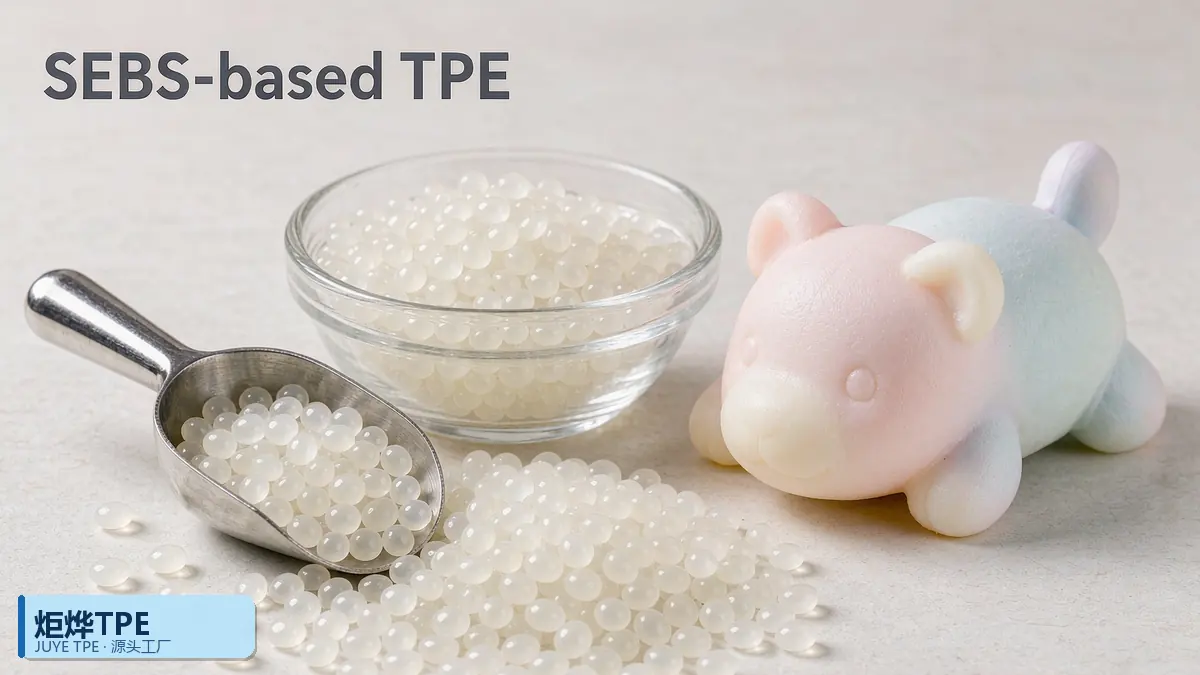
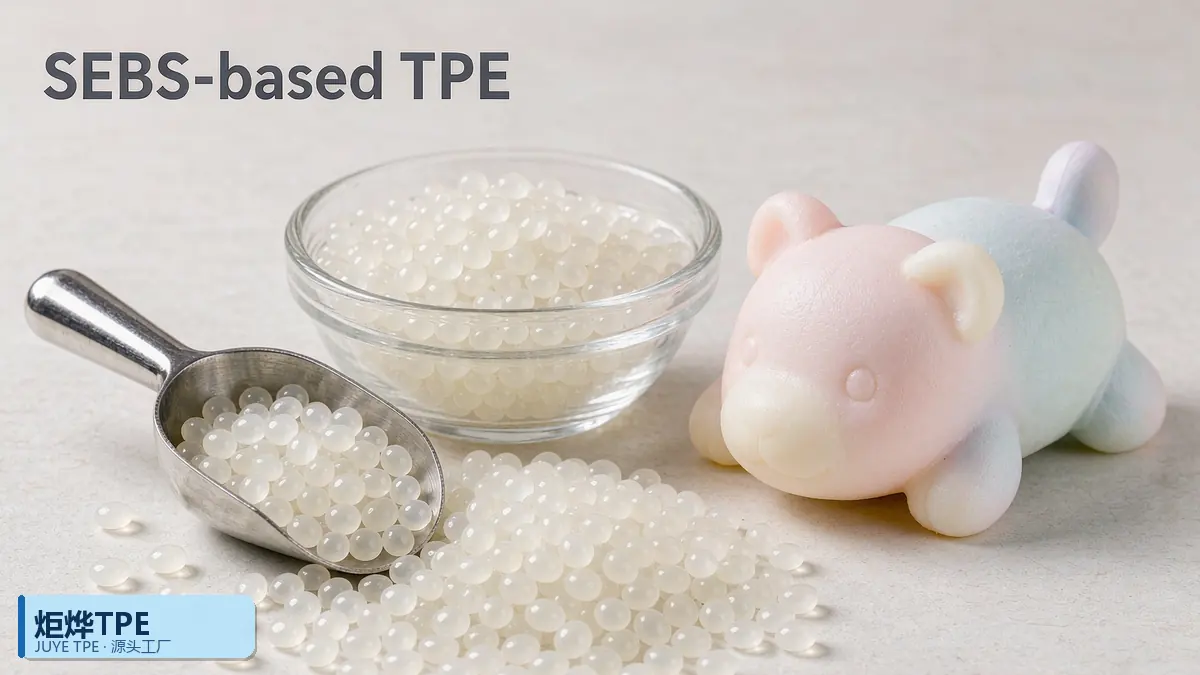
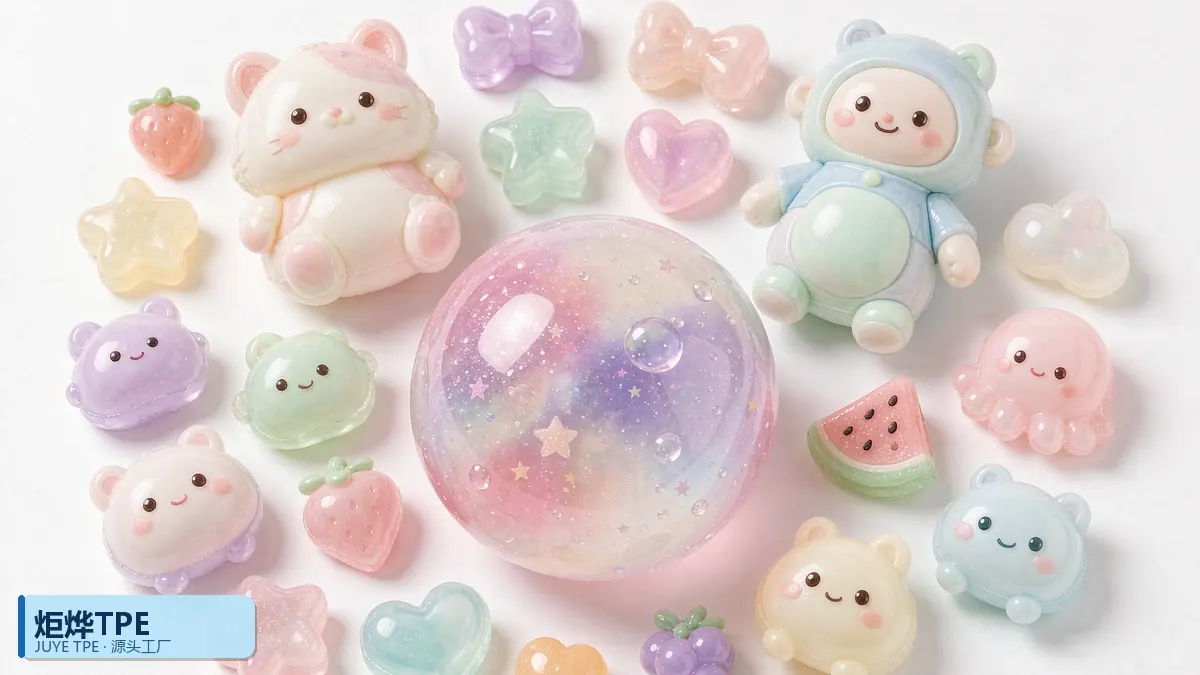
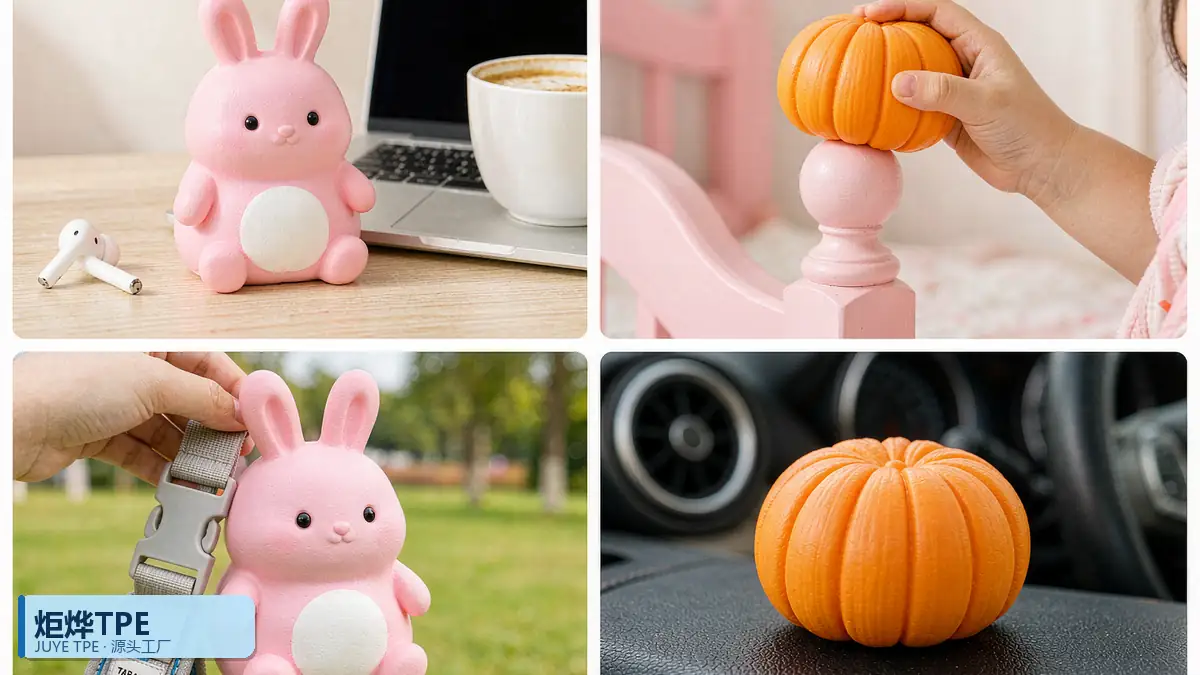
One-line answer: For stress-relief and squishy toys, the soul is ultra-soft hand-feel plus slow rebound — and only SEBS-based TPE can deliver both reliably. It covers Shore 00A 0–20A, tunes rebound time from 0.3 s to 3 s, costs one-third to one-eighth of silicone, and injection-molds at volume. That is why it pushes silicone and PU foam off the table. But get oil loading, rebound tuning, or tear strength wrong and you get the classic bad reviews: "snaps back too fast, no relief" and "turned oily and sticky after a month."
1. A real review story
A client launching an e-commerce squishy toy got two brutal one-star reviews in week two. One: "it bounces back the instant I let go — faster than a shoulder tap, zero relief." The other: "after a month a layer of oil came out, sticky to touch, my kid won't play with it."
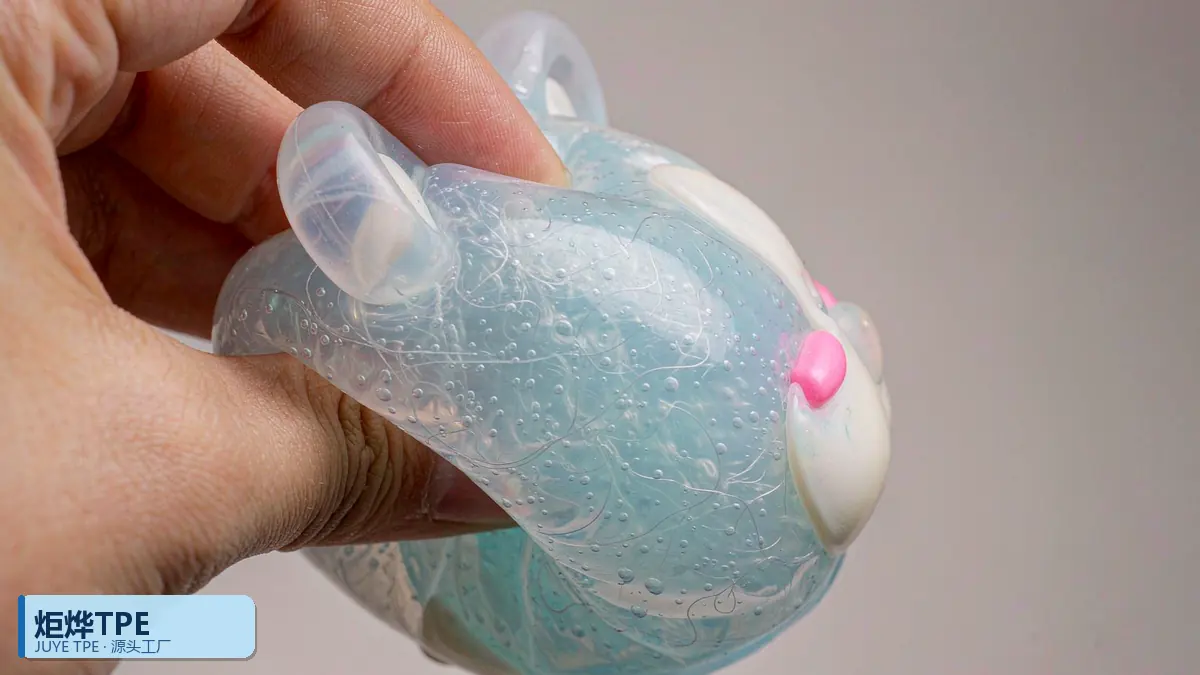
We pulled the data. Problem one was rebound: the compound was standard SEBS-based TPE with a rebound time around 0.3 s, so it recovered before the brain registered any release. Problem two was oil: to make it softer they pushed white-oil loading to nearly 300 phr, past the material's carry capacity, and the low-molecular-weight oil migrated to the surface — that sticky film.
We switched to a slow-rebound grade (rebound 1.8–2.5 s) + capped oil at 180 phr + added a surface slip treatment. Repeat-purchase climbed. The lesson stuck: a stress toy sells not on "soft" but on "soft-just-right and slow-to-return." And those two parameters are exactly what TPE does best — and what gets botched most often.
2. Why almost every stress toy uses TPE
Stress toys (squishies, squeeze balls, rebound figures, stress keyboards, slow-rebound cubes) ask for contradictory things: extremely soft, survives repeated squeezing, non-toxic, and cheap enough to scale. TPE is the only material that maxes all four.
- Unique ultra-soft range. Shore 00A 0–20A jelly feel is stable in SEBS-based TPE; silicone struggles at ultra-soft, PU foam is non-recyclable
- Tunable rebound. 0.3 s fast to 3 s slow, by formulation — this is the source of the "relief" feel
- Reachable compliance. Food-grade SEBS TPE passes FDA 21 CFR 177.2600 and LFGB; phthalates, heavy metals, formamide all controllable to toy limits
- Low cost, injection-moldable. Short cycle, multi-cavity, one-third to one-eighth the cost of silicone
- Recyclable. Regrind and reuse scrap, fitting EU/US green procurement
Silicone is too expensive, PU foam carries odor and formamide concerns and is hard to recycle — so the squishies and squeeze balls you see are overwhelmingly TPE underneath.
3. The secret of ultra-soft: Shore 00A and slow rebound
First, the durometer. Ordinary TPE reports Shore A for firmer materials; ultra-soft needs Shore 00 (Shore 00A) — a blunter pin, softer range, built for jelly materials. Stress toys sit mainly at Shore 00A 5–20A; below 5A it loses shape and won't hold a squeeze.
Rebound is the heart of the relief feel. Rebound time = how long to recover to 90% height, in two bands:
Fast (0.3–0.8 s): Q-bouncy and crisp — squeeze balls, rebound figures you want to squeeze again. Slow (1.5–3 s): drifts back lazily, strong psychological release — the mainstream for squishy stress toys.
Key data (always cite with conditions): rebound by GB/T 1681 / ISO 4662 ball-rebound at 23°C; ultra-soft SEBS TPE rebound rate tunes ~20%–65% (ISO 4662), and slow-rebound grades hit 1.5–3 s recovery via lower crosslink density and higher oil.
4. TPE vs silicone vs PU foam: three-way comparison
You cannot avoid these three when selecting. The table levels the key dimensions with cited conditions.
| Dimension | SEBS-based TPE | Silicone (VMQ/LSR) | PU foam (slow-rebound) |
| Ultra-soft reachable | Shore 00A 0–20A | 10–70A, struggles ultra-soft | variable by density |
| Rebound | 0.3–3 s tunable | fast mainly | classic slow |
| Relative cost | Low (1/3–1/8 of silicone) | High | Medium |
| Oil-bleed risk | oil grades yes, controllable | None | None |
| Color / clarity | easy color, semi/transparent | semi-clear mainly | mostly opaque |
| Process | injection, short cycle, multi-cavity | compression/LSR, slow | foaming/molding |
| Recyclable | regrind reusable | not reusable | hard to recycle |
| Long-term service temp | −40~80°C | −60~200°C | Medium |
| Toy safety (formamide/odor) | controllable compliant | Excellent | blowing-agent residue must be tight |
Table 4-1 note: typical ranges; confirm against supplier TDS and third-party toy test reports. EU EN 71-9 caps formamide in foam at <0.02%.
The takeaway: cheap, scalable, ultra-soft, recyclable → TPE. Only step up to silicone for 200°C or implant grades. PU foam only when you specifically want memory-foam feel AND can clear formamide compliance.
5. Three formulation knobs: oil, rebound, tear
"Soft" is not enough; three knobs decide success:
Oil loading (white oil, phr). Oil softens and lubricates, but it is free small molecules hosted in the SEBS network; too much (near 300 phr) bleeds to the surface as a film. Keep it 120–200 phr, and add a migration inhibitor above that.
Rebound tuning. Lower crosslink density, raise oil, add silicone masterbatch → slow-rebound band; reverse for Q-bounce. Rebound rate (ISO 4662, 23°C) tunes ~20%–65% in standard SEBS TPE.
Tear strength. For repeated squeezing, trouser-tear strength (ISO 34 / ASTM D624) should reach 15–40 kN/m or a fingernail pops it. Polar resin, oil cap, and surface slip all help.
6. Process: injection, dip-mold, or foam
- Injection (mainstream). SEBS TPE, multi-cavity, 20–40 s per part, lowest cost and best shape. Slow-rebound grades also inject, just watch venting and packing
- Dip-mold / cast. Liquid TPE/TPR poured and baked — good for hollow, irregular figures, but slower and labor-heavy
- Foam. Chemical/physical blowing for light slow-rebound parts, memory-foam feel, but tight blowing-agent and formamide control
Our squeeze balls and squishies are almost all injection — only injection gets unit cost low enough to profit at a few-dollar retail. Hollow soft figures go dip-mold.
7. Compliance is the floor, especially for children
Stress toys skew heavily to children and emotional consumers; compliance is the entry ticket, not a bonus. Hard lines for EU and US:
- Phthalates: EU EN 71-3 / 2009/48/EC, <0.1% (sum of DEHP/DBP/BBP/DINP etc.)
- Heavy-metal migration: EN 71-3 eight-metal extractable limits (Ni, Pb, Cd…)
- Formamide: foam EN 71-9, <0.02% — the easiest PU-foam failure
- PAHs: Germany GS / REACH Annex XVII, very tight for short skin-contact
- US lines: ASTM F963, CPSIA (Pb <100 ppm, phthalates <0.1%), California Prop 65
- Food contact: mouthable items (teethers) pass FDA 21 CFR 177.2600 n-hexane extract and EU LFGB
Our standing rule for brands: every batch ships with TDS + SDS + third-party toy test report — never order on the words "eco-friendly" alone.
8. Five common failures and fixes
Failure 1: oily, sticky surface. Over-oiling or no inhibitor. Fix: cap white oil 120–200 phr, add migration inhibitor, surface slip/cure treatment.
Failure 2: rebounds too fast, no relief. Standard-rebound compound. Fix: lower crosslink + higher oil + silicone masterbatch to push rebound to 1.5–3 s (verify ISO 4662).
Failure 3: tears at a fingernail. Tear strength too low. Fix: trouser-tear (ISO 34) ≥15 kN/m, cap oil, add polar resin.
Failure 4: yellowing / darkening. SBS-based or unstable oil. Fix: ultra-soft MUST be SEBS-based; add stabilizer/antioxidant, mandatory for EU/US outdoor/long-display items.
Failure 5: strong odor, fails VDA 270. High-odor base or additive. Fix: low-odor SEBS grade, control odor to ≤3.0 by VDA 270, ventilate storage.
9. Design checklist for buyers / brands
Run this before cutting the tool — saves two mold revisions and a pile of bad reviews:
- Target feel: ultra-soft (00A value) + fast or slow rebound — fix before compounding
- Durometer: report Shore 00A for ultra-soft, not vague Shore A
- Oil cap: agree max white-oil phr and oil-bleed acceptance (e.g. no film at 60°C × 7d)
- Tear strength: require ISO 34 trouser-tear ≥15 kN/m (higher for kids)
- Rebound time: write into spec, accept per ISO 4662
- Color / clarity / surface: Pantone, transparent or not, slip or matte
- Compliance: destination + EN 71-3 / ASTM F963 / LFGB / phthalates / formamide
- Odor: VDA 270 grade
- Wall thickness: uniform on ultra-soft, 2–5 mm typical, avoid sink and flow marks
- Validation: sample rebound + aging (70°C × 7d / UV) + thermal cycle before volume
10. Eight things to ask your supplier when quoting
From the factory side, the worst RFQ is "I need soft TPE for a stress toy." We will not quote it — more missing than given. A proper RFQ includes at least:
- Target hardness (Shore 00A value) and test method
- Rebound requirement: fast or slow, target seconds
- User group: adult stress or child toy (sets compliance level)
- Color / clarity / surface: Pantone, slip or matte
- Process: injection / dip-mold / foam — sets the compound type
- Compliance: destination and standards (EN 71-3 / ASTM F963 / LFGB)
- Odor grade: VDA 270 requirement
- Volume and sampling: pilot 10–50 kg before a long-term contract?
When receiving samples, always ask: grade and supplier, TDS/SDS, third-party toy test report, measured hardness (Shore 00A) and rebound time, MOQ. A factory that quotes a grade on "I need soft" alone either doesn't understand ultra-soft compounds or isn't planning a long-term project with you.
11. Conclusion
Back to the opening: a stress toy sells not on "soft" but on "soft-just-right and slow-to-return." SEBS-based TPE maxes ultra-soft hardness (Shore 00A 0–20A), tunable rebound (0.3–3 s), low cost, injection scale, and compliance at once — that is why it is the default substrate for stress toys.
But the same material, 30 phr difference in oil or one rebound band off, becomes "five-star relief" or "oily one-star" in the customer's hand. The threshold was never "soft or not" — it was whether you locked rebound time, oil cap, and tear strength.
About the author
This article was written by the technical team at Dongguan Juye Plastic Technology Co., Ltd. (Juye TPE), a source-factory supplier of TPE / TPR / TPV / TPU / TPEE / TPV-SIR compounds for artificial flowers, pet toys, stress-relief toys, and two-shot overmolding.
Hardness, rebound, tear, oil-loading and compliance figures cited are typical ranges under ISO 48, ISO 4662, ISO 34, GB/T 1681, EN 71-3, ASTM F963; specific grades follow the supplier TDS and third-party test reports. For substrate-specific slow-rebound formulation samples and quotes, contact
[email protected].
FAQ
1. TPE or silicone for a squishy toy?
It depends on budget and volume. TPE (SEBS) costs one-third to one-eighth of silicone, injection-molds at multi-cavity scale, and does ultra-soft Shore 00A 0–20A and slow rebound — it is the substrate under ~90% of market squishies. Silicone wins on 200°C resistance and zero oil-bleed but is costly and hard to scale; reserve it for premium or heat-needing items. Standard stress toys are fine in TPE.
2. Why does my stress toy snap back too fast?
Rebound time is too short. Standard SEBS TPE rebounds in ~0.3 s (ISO 4662, 23°C) — it recovers before the brain feels release. For the "relief" feel use a slow-rebound grade pushing rebound to 1.5–3 s via lower crosslink density, higher oil, and silicone masterbatch. Write the rebound time into the spec and accept per ISO 4662.
3. How to fix oily, sticky surface on a stress toy?
Root cause is over-oiling (white oil near 300 phr bleeds) or no migration inhibitor. Fix: cap white oil at 120–200 phr, add a low-molecular migration inhibitor, surface slip/cure treatment; acceptance can specify no oil film at 60°C × 7 days. Require the oil-bleed standard from the supplier.
4. What compliance does a TPE stress toy need for export?
EU: EN 71-3 heavy-metal migration, EN 71-9 organics (formamide <0.02% for foam), REACH SVHC, PAHs. US: ASTM F963, CPSIA (Pb <100 ppm, phthalates <0.1%), California Prop 65. Mouthable items add FDA 21 CFR 177.2600 / LFGB. Every batch should ship TDS, SDS and a third-party toy test report.
5. Which durometer for ultra-soft TPE?
Ultra-soft (jelly) materials need a Shore 00 (Shore 00A) durometer— blunter pin, softer range, built for 00A 0–20A. Ordinary Shore A misreads it. Stress toys sit mainly at Shore 00A 5–20A; below 5A it loses shape and won't hold a squeeze.
6. What tear strength prevents popping?
For repeated squeezing, trouser-tear strength (ISO 34 / ASTM D624) should reach ≥15 kN/m, higher for children's items (15–40 kN/m). Too low and a fingernail pops it. Improve by capping oil, adding polar resin, surface slip treatment. Write tear strength into the spec and accept it.
Prev : None
Next : None