
Your local language

PRODUCTS

JUYE Technology, a TPE thermoplastic elastomer manufacturer with 19 years of experience — provides you with comprehensive R&D and production solutions for TPE, TPR, TPV, TPV-SiR, TPU, and TPEE materials.

Classification by Material
Classification by Application Field
By Process Classification

MARKETS

Since 2008, we have expanded into a broad range of industry application markets, providing rich solutions for various industries, with numerous application cases for your reference.

Industry Solutions
Market Application Cases

SYNTHESIS

The processing and production technology of TPE materials is relatively complex, requiring strict control of the process parameters and operating conditions at each stage.

Synthesis Process

SERVICES

Juye Technology has gone through nearly 20 years of steady development and has established a comprehensive and thoughtful service support system.

MEDIA

Through the media information channel, you can get the latest updates on JUYE Technology Company's development and industry news in the first time. The FAQ and video center allow you to better explore the world of TPE materials.

SUSTAINABILITY

JUYE Technology's sustainable development aims to carry out low-carbon production under the premise of protecting the Earth's green environment, participate in global economic cooperation and innovation practices, establish harmonious and symbiotic relationships with partners, contribute to the country, promote the development of the enterprise, and seek welfare for employees.

ABOUT

Dongguan JUYE Plastic Technology Co., Ltd. is a TPE thermoplastic elastomer company integrating research and development, production, and sales.

Extrusion Molding

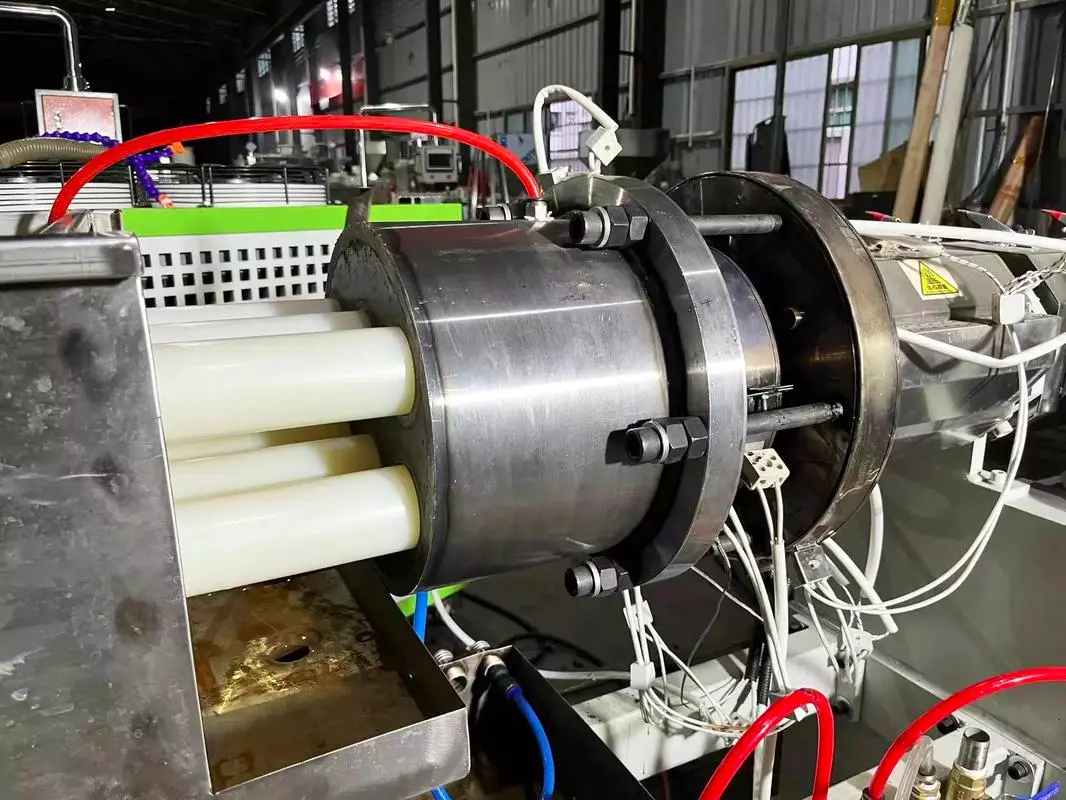
TPE can be continuously extruded to produce products such as rubber strips, pipes, and cable sheaths. Raw materials are dried as needed, then melted in an extruder, extruded through a die, hauled, cooled, and shaped. No vulcanization is required, and offcuts can be recycled. Finished products have good elasticity and efficient processing.
HOME > SYNTHESIS > Synthesis Process > Extrusion Molding

Thermoplastic elastomer TPE, with its rubber-like elasticity and thermoplastic processing characteristics of plastics, is a commonly used soft rubber material for extrusion processes. It can continuously produce long-strip products such as cable sheaths, sealing strips, hoses, decorative profiles, and composite rubber-coated strips. Extrusion processing imposes strict requirements on the rheology, thermal stability, and melt strength of raw materials. Before production, drying pretreatment must be carried out according to the material type: SEBS, SBS, and TPV only need drying at 70°C for 2 hours in humid environments, while TPU, due to its strong hygroscopicity, must undergo dehumidifying drying at 85°C for 3 to 4 hours. Strict moisture control is necessary to avoid bubbles and silver streak defects in products.

The process uses a single-screw extruder with a length-to-diameter ratio of 20:1 to 25:1, with segmented temperature control based on TPE hardness and type. SEBS processing range is 150–195°C; SBS is overall reduced by 10–15°C to prevent high-temperature degradation; TPV and TPU processing temperatures are higher, at 190–210°C. The screw adopts a low-shear gradual structure, combined with reasonable back pressure to stabilize melt plasticization, maintaining head pressure at 5–15 MPa, and matching screw speeds of 30–150 rpm according to softness and hardness.

The molten material, after being extruded through a streamlined die, undergoes die swell and requires matching hauling with a draw ratio of 1.1–1.5, followed by cooling and shaping in a low-temperature water bath or vacuum calibration tank. For soft TPE, cooling water temperature is controlled at 15–25°C; for hard TPV and TPU, water temperature is raised to 30–40°C to ensure dimensional stability and prevent sticking.

Extruded TPE products offer high production efficiency, and offcuts can be recycled and reprocessed. They possess excellent resilience, abrasion resistance, and weather resistance. TPV products are often used for automotive sealing parts, SEBS products are suitable for daily-use soft rubber profiles, and TPU extruded parts focus on abrasion-resistant hydraulic hoses. During processing, issues such as shark skin, strip breakage, and dimensional fluctuations can be improved by adjusting temperature, screw speed, and hauling speed. Finished products require no vulcanization, the process flow is short, and overall costs are superior to traditional rubber extruded parts.
Have Questions? We are Here to Help You!

Professional technical engineer team-possible fastest response and support to client' application demand.

CONTACT US

Dongguan JUYE Plastics Technology Co.,Ltd.

No. 2, Fourth Street, Shuju Second Industrial Zone, Changping Town, Dongguan City, Guangdong Province, China
juyetpe@juyetpe.com
+86-769-82827851
+86-769-82827951
+86 13827205072
Ms. Zhang
CONTACT US
facebook
tiktok
youtube
alibaba
wechat
whatsapp