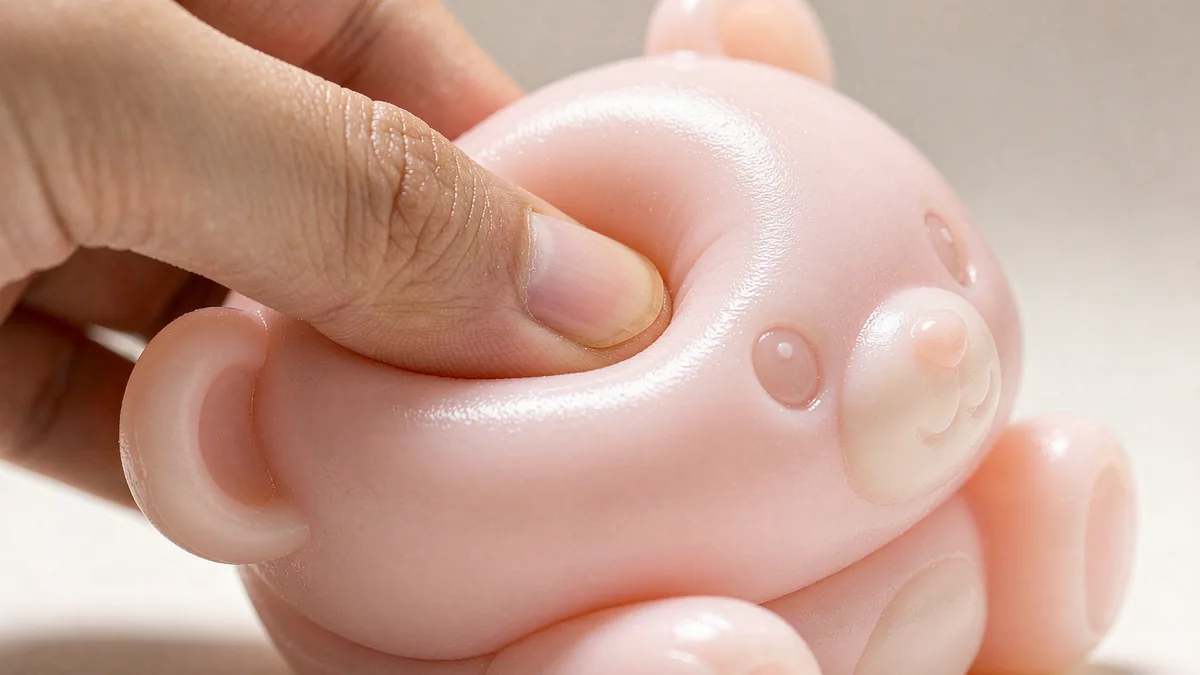
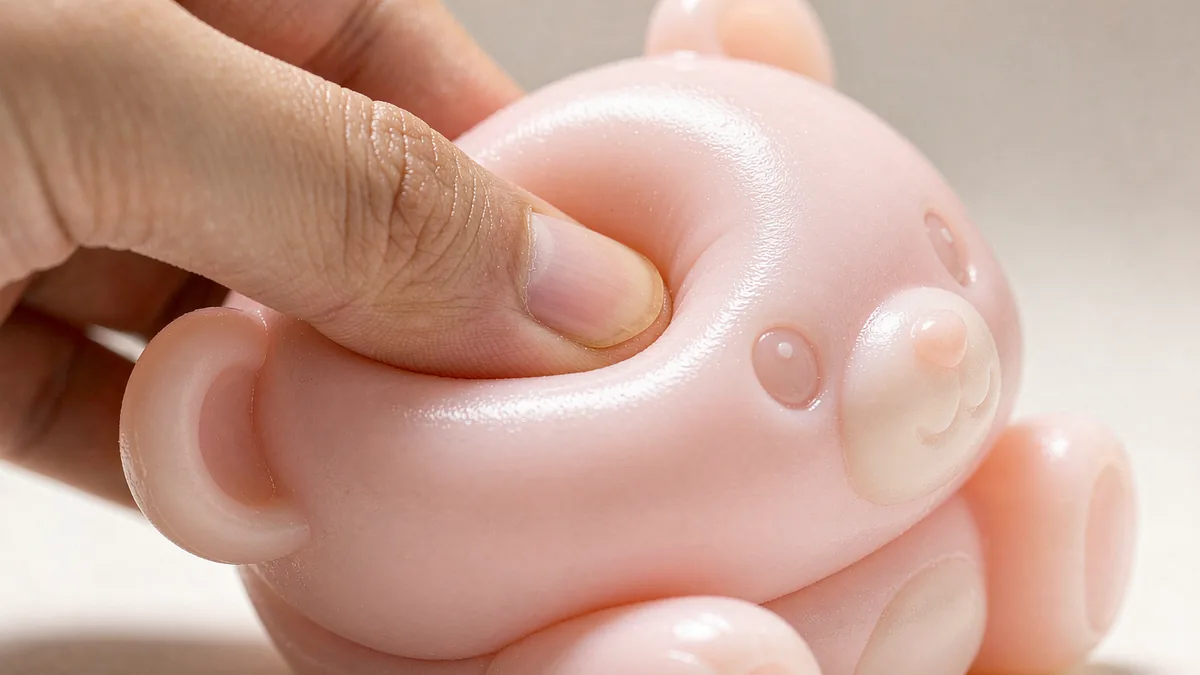
We made comparison samples from three grades (same mold, same process, 50 pieces each):<\/div>
<\/div>
| Grade<\/b><\/td> | Hardness<\/b><\/td> | Rebound rate (ASTM D2632, 23℃)<\/b><\/td> | Compression set (ISO 815, 23℃×72h)<\/b><\/td> | Hand-feel evaluation<\/b><\/td><\/tr>
|
| Original general-purpose 20A<\/td> | 20A<\/td> | 31% | 46% | Collapses as soon as you squeeze it, doesn't bounce back |
| Candidate A 30A | 30A | 45% | 33% | Bounces back enough, ears a bit soft |
| Selected 35A plush material | 35A | 52% | 27% | Squeezable, holds its shape, bounces back within 1 second |
Note for Table 2-1: Rebound rate and compression set are both measured at 23℃, with 5 sampling points from the same batch of material and the same mold cavity, taking the median value.
The final main body uses 35A, while details like the ears and tail separately use 28A to create a layered feel, with the hardness difference between the two controlled within ±3A so it doesn't feel disjointed.
Step 2: Change the structure—the ears collapsing isn't because the material is soft, it's because of the huge difference in wall thickness
Look at the cross-section: the main body is solid at 6mm, but the root of the ear is only 1.8mm, and the transition in between is still a right angle. The thick area cools slowly, the thin area cools quickly, and the shrinkage is not synchronized. The thin side gets pulled along, so it is already warped when demolded, and after it cools completely it sets in the warped state.
Three changes:
- Reduce the main body thickness to 4.2mm (a solid part does not need to be that thick, and this also shortens cooling)
- Thicken the ear root to 2.6mm; for slender parts like flat ears, use "root ≈ 1.2 times the local wall thickness"
- Change all right-angle transitions from 6mm to 1.8mm into R2 fillets
After the structural changes, the proportion of warped ears dropped from 9 out of 30 sampled pieces to 1 out of 30.
Step 3: Add venting + adjust the process—those spots that are "as hard as another figurine"
The ear tips are at the very end of the mold, so air cannot escape and the material cannot reach the bottom. What comes out is shiny, hard, and slightly short of material. This kind of defect is not short of material and is not burnt, and you cannot see it at all unless you look closely, but you know it is wrong as soon as you touch it.
Four changes were made to the mold:
- Add vent pins at the ear tips and tail end (gap 0.015mm)
- Cut vent grooves on the parting surface, depth 0.025mm, width 4mm
- Polish the mold surface from Ra 0.8μm to Ra ≤0.2μm (soft material sticks to the mold; if the mold surface isn't shiny, it causes drag marks)
- Increase the draft angle by 1.5° compared with the original design
Process parameters were adjusted accordingly (see the comparison table below). The core logic is "raise the mold temperature, lower the holding pressure": low mold temperature causes flow marks on the surface and high internal stress; long holding time "over-packs" the part, making the rebound feel dead.
| Parameter | Before correction | After correction | Why change |
| Melt temperature | 205℃ | 195℃ | Soft material at high temperature easily sticks to the mold and shrinks |
| Mold temperature | 28℃ | 45℃ | Raise mold temperature to eliminate flow marks and reduce internal stress |
| Hold time | 8s | 4s | Too long hold causes rebound to become "dead" |
| Cooling time | 22s | 34s | Allow enough based on wall thickness 4.2mm×8s |
| Cycle | 32s | 41s | Cooling is longer, but lower defect rate is more cost-effective |
Table 2-2 Note: Although the cycle is 9 seconds longer, the first-pass inspection qualification rate increased from 82% to 97.5%, and the overall cost per piece actually decreased.
Step 4: Change packaging—qualified at factory, deformed when reaching the customer
This step is most easily overlooked, but nearly half of the customer's 12% returns are "flat as soon as the bag is opened." TPE soft rubber will "remember its shape" under continuous pressure; the longer it is pressed and the higher the temperature, the worse the recovery. The original packaging was a ziplock bag + one carton of 120 pieces stacked in three layers. At 60℃ in a truck in summer, it was equivalent to giving the figure a shaping treatment.
The fix is crude but effective: single blister tray positioning, stacking no more than 3 layers per carton, storage temperature kept below 40℃, and a rigid cardboard tray added for courier bag shipping. After the fix, similar customer complaints were basically eliminated.
Remediation results: retest data from three consecutive customer batches
After remediation, the customer ran three consecutive batches (20,000 units each), sampling 500 units per batch for full-item retesting:
| Metric | Before remediation | After remediation | Test conditions |
| Rebound rate | 31% | 52% | ASTM D2632, 23℃ |
| Compression set | 46% | 27% | ISO 815, 23℃×72h, 25% compression |
| Feel recovery time | >5s (some did not recover) | 0.8~1.2s | Internal control: compress 50% and hold 10s, measure recovery to 95% height |
| Ear root wall thickness | 1.8mm | 2.6mm | Ultrasonic thickness measurement, 5 points/piece |
| Ear skew defect rate | 30% | 3.3% | Sampling inspection 30 pieces/batch, visual + platform test |
| First-pass inspection qualification rate | 82% | 97.5% | Factory full inspection statistics |
| Customer complaint rate (returns/shipments) | 12% | Below 1.5% | Store backend data for 3 consecutive months |
| Material cost per piece | Baseline | +0.15 yuan | Material unit price increased by 6%, offset by part of the material reduction |
Note for Table 2-3: The customer complaint rate is based on the "quality-related returns" metric in the customer's store backend, excluding logistics damage.
The customer did the math: a single piece of material costs 0.15 yuan more, but the losses from returns, rework, and negative reviews, converted at the original level, exceed 0.9 yuan per piece, so the overall cost after the improvement is lower. This is also something we always tell customers: The money in soft rubber parts isn't in the material price, it's in the defect rate and return rate.
III. How to define rebound: first align on three metrics
When you talk to a supplier about "whether the rebound is good," nine times out of ten you can't reach an agreement, because in a factory "rebound" actually refers to three different metrics. First, align the definitions:
| Metric | Meaning | Recommended range (figures) | Test conditions |
| Rebound rate | The material's own elastic recovery capability | 45~65% | ASTM D2632 vertical rebound (or GB/T 1681), 23°C |
| Compression set | How much is permanently lost after compression | ≤30% | ISO 815, 23℃×72h, compression set 25% |
| Recovery time (hand feel) | How quickly it returns to its original shape after being squeezed flat | Adjustable from 0.3 to 3s | Internal control: compress 50% and hold for 10s, measure the time to return to 95% height |
Note for Table 3-1: The three indicators point in different directions—a high rebound rate does not mean good hand feel. Slow-rebound toys need a "low rebound rate and long recovery time," while regular figures need a "medium-to-high rebound rate and fast recovery."
In one sentence: First define the hand feel (fast rebound or slow rebound), then define the indicator ranges, and only then discuss hardness. If you do it the other way around, samples will definitely need to be revised back and forth.
IV. How to determine hardness: match each figure to a row in the table
| Figure Type | Main Body Hardness (ISO 48) | Details (Ears/Tail/Hands) | Selection Tips |
| Squishy Toy Figures | 25~30A | 20~25A | The softer, the stickier; apply a matte finish to the surface |
| Standard Soft PVC Figures (8~12cm) | 30~40A | 25~35A | General-purpose volume grade; balanced rebound and stiffness |
| Display/Collectible Figures | 40~50A | 35~45A | Must stand upright; details must not sag |
| Keychain/Pendant Figures | 40~50A | — | Wear resistance first; reinforce the hanging hole area |
| Baby Teether-Shaped Figures | 25~35A | — | Full EN71-3 compliance; no small parts |
Table 4-1 Note: A hardness difference of 5A corresponds to a one-notch difference in feel. Different parts of the same figure can have a hardness difference (dual-color, dual-material), but the tolerance must be controlled within ±3A; otherwise, the feel will be inconsistent.
The problem with the earlier case lies here: making an 8cm figure with 20A, the main body is too soft, and the ears are thin, so it collapses as soon as it is pinched. Switching to a 35A main body + 28A ears, the feel immediately "came back".
V. Wall Thickness and Internal Structure: The Structural Logic of Rebound
Material only determines the upper limit; structure determines the lower limit. With the same material, different structures can make the rebound performance differ by a factor of two.
Three hard rules for wall thickness:
- Uniformity ±10%: For a part with a main body wall thickness of 3mm, the thinnest point must not be less than 2.7mm. Locations with drastic thickness differences cool at different rates and shrink differently, causing the thin side to be pulled out of shape
- Thickness transition R ≥1mm: Transitioning from 6mm to 1.8mm must use a fillet; a right-angle transition is a stress concentration point and also the starting point of collapse
- Thicken details separately:For slender parts like ears, tails, and fingers, make the thickness at the base 1.2 times the local wall thickness of the main body; otherwise they will definitely warp
How to choose among the three internal structures:
| Structure | Method | Rebound performance | Application |
| Solid | Fully solid injection molding | Most stable rebound, uses more material, slow cooling | Small sizes (≤6cm), ornaments, keychains |
| Hollow (blow molding/two-piece assembly) | Outer shell 2.5~4mm, internal cavity | Light, good squeeze feel, but high requirements for wall thickness uniformity | Medium and large figures, blind boxes |
| Skeleton + soft wrap | Hard plastic skeleton + TPE outer layer | Most stable shape, high cost, many processes | Figures that need to stand/joints be movable |
Table 5-1 Note: Hollow structures are the most prone to "not bouncing back after squeezing," because the walls are thin, internal stress is high, and when venting is poor, residual air in the cavity pushes against it, slowing the rebound. Hollow parts must have vent pins.
VI. Venting and Mold Design: The Most Easily Overlooked Link
The signs of trapped air are very subtle: no short shot, no burning, but locally glossy, higher density, harder than normal, and when you touch it, "this part doesn't feel like the same figure as the rest." In the case, the tip of the ear was exactly like this.
| Location | Method | Description |
| Parting surface | Vent groove depth 0.02~0.03mm, width 3~5mm | Too deep causes flash, too shallow cannot vent |
| Insert/Ejector pin position | Use ejector pins as venting ejector pins (0.01~0.02mm clearance) | Essential for deep-cavity parts |
| End of slender sections | Add vent pins or vent inserts | Ears, tails, corners |
| Mold surface treatment | Mirror polishing (Ra ≤0.2μm) | Soft material sticks to mold; dull mold surface causes drag marks on parts |
| Draft angle | 1~2 degrees more than conventional materials | Soft material has strong mold-gripping force |
Table 6-1 Note: TPE soft material has good flowability and easily sticks to the mold; venting and polishing must be done together; venting alone without polishing will still cause tearing during demolding.
VII. Cooling and Molding: How to Implement the Parameters
| Parameter | Recommended Value | Description |
| Material Temperature | 180~210℃ | For soft materials, use the lower limit; if the temperature is too high, it will stick to the mold and cause shrinkage |
| Mold Temperature | 30~50℃ (45~55℃ for mirror-finish parts) | Low mold temperature causes surface flow marks; high mold temperature lengthens the cycle |
| Holding pressure | As long as there is no sinking, shorter is better than longer | Excessive holding pressure creates high internal stress, and the rebound becomes "dead" |
| Cooling time | Wall thickness (mm) × 8~12s | For a 3mm wall thickness, about 25~35s |
| Cycle | 25~40s (including part removal) | Add another 20% for hollow parts |
| Shrinkage rate | 1.5~2.5% | The higher the oil fill, the greater the shrinkage; the mold must be pre-compensated |
Table 7-1 Note: Insufficient cooling is the most common source of "rebound decay"—at demolding the interior is still soft, and it deforms as soon as the ejector pins push it; once fully cooled, it sets in the deformed state.
VIII. Packaging and Warehousing: Passes Inspection at the Factory, Deforms in the Customer's Hands
This is the stage of e-commerce channels most prone to failure. TPE soft rubber will "remember its shape" under sustained pressure (the macroscopic manifestation of compression set); the longer it is compressed and the higher the temperature, the worse the recovery.
- Individually packaged per unit, do not stack in bulk; blister/thermoformed positioning is better than ziplock bags
- Stack no more than 3 layers, keep whole-carton compression deformation within 20%
- Storage temperature ≤40℃, avoid direct sunlight, do not stack against the wall in a metal shed
- Transport: courier bag shipments must include a rigid cardboard tray; bare shipping for more than 3 days will inevitably crush them flat
In the case, that batch that was "crushed flat and could not recover" was due to ziplock bags + three-layer stacking + summer truck compartments. After adding blister trays + reducing layers, similar customer complaints were basically eliminated.
IX. Key Parameters in One Table
| Parameter | Recommended Value | Test Conditions | Description |
| Hardness (main body) | Shore 30~40A | ISO 48 / ASTM D2240, 23℃ | Squishy toys 25~30A, figurines 40~50A |
| Rebound rate | 45~65% | ASTM D2632, 23℃ | Slow-rebound toys conversely take 20~40% |
| Compression set | ≤30% | ISO 815, 23℃×72h | The lower, the more it "bounces back" |
| Tensile strength | ≥ 6 MPa | ISO 37, 23℃, 500mm/min | The baseline for details not breaking |
| Elongation at break | ≥ 500% | ISO 37, 23℃ | Repeated kneading without cracking |
| Tear strength | ≥ 18 kN/m | ISO 34-1 | Critical at ear bases and hanging holes |
| Wall thickness uniformity | ±10% | Ultrasonic thickness measurement, 5 points/piece sampling | Hard constraint of structural design |
| Density | 0.90~1.00 g/cm³ | ISO 1183, 23℃ | Affects hand feel and cost accounting |
| Compliance | EN71-3 / CPSIA / Phthalates 6P | Third-party report | Export baseline |
Table 9-1 Note: The above are typical ranges for figurine-type SEBS-based TPE; refer to the TDS for specific grades.
X. Real Mold Sampling and Verification Checklist (10 Items)
This checklist is what we actually run during sampling with customers; missing any one item easily leads to problems in mass production or at the customer end:
| # | Item | Method/Standard | Criterion |
| 1 | First article full dimensions | Caliper + 2D vision, 8~12 key points | Within tolerance, wall thickness ±10% |
| 2 | Hardness sampling | ISO 48, 3 points per cavity | Target value ±3A |
| 3 | Rebound rate | ASTM D2632 | 45~65% (or per slow-rebound target) |
| 4 | Compression set | ISO 815, 23℃×72h, 25% compression | ≤30% |
| 5 | Feel recovery time | Internal control: compress 50% hold 10s, measure time to recover 95% | Per target 0.3~3s |
| 6 | Drop test | 1.2m, 1 time on each of 6 faces | No cracking, no permanent deformation |
| 7 | Aging | 70℃×7d, then retest hardness and rebound | Hardness change ≤5A, no oil bleeding |
| 8 | Packaging simulation | Full carton stacking 3 layers 72h + 40℃ | Returns to original shape within 2h after removal |
| 9 | Compliance | EN71-3 / CPSIA / Phthalates 6P / Odor | All passed |
| 10 | Blind test | 30 units, target user hand-feel scoring | Average ≥4 points (5-point scale) |
Note to Table 10-1: Items 5, 7, and 8 were added by us; they are not in the third-party report—but these three items correspond exactly to the three most frequent customer complaints: "doesn't bounce back after squeezing," "gets sticky after sitting for a while," and "crushed flat in shipping."
XI. Five Common Failure Modes and Countermeasures
| Failure | Root cause | Countermeasure |
| Leaves a dent after squeezing, won't recover | Hardness too low / holding pressure too long / insufficient cooling | Increase hardness by 5A, shorten holding pressure, increase cooling to wall thickness × 10s |
| Ears and tail collapsed, crooked | Insufficient wall thickness in details / uneven cooling | Thicken the root to 1.2 times the local wall thickness of the main body, transition R≥1mm |
| Local shiny spots, harder areas | Trapped air | Add vent grooves/vent pins, polish the mold surface |
| Surface flow marks, streaking | Low mold temperature / dull mold surface | Raise mold temperature above 45℃, mirror polish |
| Flattened after packing, oil bleeding and sticky | Packaging compression / excessive oil filling | Blister tray + stacking ≤3 layers; reduce oil, switch to low-bleed grade |
Table 11-1 Note: For failure troubleshooting, check the timeline first—if it is present right from the factory, check the process; if it appears only after a few days, check the formula and packaging.
XII. How to match different figures: a comparison table
| Product | Body Hardness | Structure | Key Points |
| Small figures under 6cm | 35~45A | Solid | Fast cooling, watch for shrinkage |
| 8~12cm blind box figures | 30~40A | Hollow 2.5~4mm | Vent pins essential, uniform wall thickness |
| Plush figures over 15cm | 25~35A | Hollow/skeleton | Large parts cool slowly, zone mold temperature |
| Articulated figures | 40~50A | Skeleton + soft overmold | Joints wear-resistant, tear-resistant |
| Slow-rebound stress-relief figures | 20~30A (or 00 scale) | Solid | Rebound rate 20~40%, recovery 1~3s |
Table 12-1 Note: Slow-rebound models use a different formulation logic from regular figures; do not apply the same set of parameters.
XIII.FAQ Frequently Asked Questions
1. When a TPE figure doesn't bounce back after being squeezed, is it a material problem or a mold problem?
Most of the time it's both combined. Check in order: first see whether the hardness is below 30A, whether the hold pressure is too long, and whether cooling is sufficient (these three account for 70%); then check whether the wall thickness is uniform and whether there is trapped air. Just changing the material without changing the structure usually has limited effect—in the case study, the four actions were done together.
2. What hardness is appropriate for a figure?
For regular soft-rubber figures of 8~12cm, choose Shore 30~40A; for squishy toys, 25~30A; for display pieces, 40~50A. The ears and tail of the same figure can be 5~10A lower to create a layered feel, but keep the tolerance within ±3A.
3. Why do hollow figures "collapse" more easily than solid ones?
Thin walls (2.5~4mm), high internal stress, plus trapped residual air in the cavity pushing back, will slow down the rebound. The countermeasures are to add vent pins, keep wall thickness uniform to ±10%, and allow sufficient cooling time of at least wall thickness × 10s.
4. After the figures are packed and flattened, can they recover after two days?
Slight flattening can mostly recover in 24~48 hours, but sustained pressure + high temperature (over 60℃ in a summer truck) will cause irreversible deformation. The fundamental countermeasure is packaging: blister tray positioning, stacking ≤3 layers, storage ≤40℃.
5. What tests are required for figures exported to Europe and the US?
EN71-3 (19 heavy metal migration items), REACH phthalates (TPE itself does not contain them; the risk lies in color masterbatch and oils), US CPSIA (lead content + traceability label), and for children's models additionally EN71-1 mechanical and physical properties. When placing an order, specify "for toys, target market" so the manufacturer can recommend grades according to the standards and attach reports.
6. The existing mold has already been made; can it be saved by only changing the material?
It depends on the specific symptoms. If it's "slow rebound, leaves a dent after pinching," switching to a low permanent deformation grade can usually improve it by 30% to 50%; but for the two types—collapsed ears and localized hardening—the root causes lie in wall thickness and trapped air respectively, and these can't be solved without changing the mold. Our approach is to first take 3~5 defective parts and do cross-section and venting inspections, then provide a "mold modification list + material change recommendations," calculating clearly which spots to change, how much it will cost, and how much it can improve before taking action. In the case study, this customer only changed four places (two added glue, one reduced glue, three vent pins), and the mold modification cost was less than 8% of the entire mold.
Conclusion
Back to the batch of "won't rebound after pinching" figures from the beginning. The rebound design of TPE figures is essentially about controlling six things simultaneously: hardness determines feel, wall thickness determines shape, structure determines the lower limit, venting determines consistency, cooling determines internal stress, and packaging determines the delivery experience. Material is just the entry ticket; structure and process are what earn the score.
The most valuable lesson from this case isn't "switch to 35A," but rather first distinguish which layer the problem falls on: slow rebound is a formulation issue, crooked ears are a structural issue, localized hardness is a venting issue, and flat-on-arrival is a packaging issue. Solving four types of problems with four actions is how the complaint rate dropped from 12% to below 1.5%. Expecting a single drum of material to solve everything is the most common way to take a detour.
Need to do TPE toy figure material selection, mold-opening evaluation, and prototyping? Send us the figure size, target feel (fast rebound/slow rebound), export market, and packaging method. The technical department will recommend grades based on actual needs and send free samples.
Related Reading
A few articles directly related to this content, arranged in the order of "what to read first, what to read next":
- TPE 0-degree stress toy application case: a record of converting from Shore A to Shore OO: Also a soft rubber for toys, that article discusses "how to achieve slow rebound that collapses with a squeeze," which is exactly the opposite requirement to this article's "figures must stand up." After reading it, you can distinguish the differences between the two feel systems.
- TPE solutions for toy figures: A complete material solution for using TPE in toy figures, including solutions to three common problems: oil bleeding, strong odor, and easy tearing.
- What should be noted when using TPE/TPR materials as toy figurine compounds?: Five confirmation points in the material selection stage (hardness specification, whether oil spraying is required, export testing, color matching, processing compatibility), suitable for procurement to review before looking at samples.
- Toy Figurine TPE Material Product Page: Figurine compound grades and physical property tables classified by hardness, allowing direct comparison of rebound rate and compression set.
- Toy Figurine Application Case Collection: Other figurine, squishy toy, and toy accessory cases in the same section, each with specific improvement data.
- Is TPR Material Toxic?: The compliance question most frequently asked by export customers, clarifying the essential difference between TPR/TPE and PVC in terms of plasticizers.
Online Consultation
If your plush figure also has the problems of "not bouncing back after squeezing," "ears collapsing," or "arriving flat," send us the following 8 pieces of information. The technical department will provide a preliminary assessment and material selection recommendations within 1 working day. Samples that need to be tested will be shipped in 3~5 days (minimum 2kg per grade, with TDS and test reports attached):
- Figure size, weight per piece, and main body wall thickness (cross-section drawing preferred)
- Target hardness and test standard (specify ISO 48 or ASTM D2240)
- Target feel: fast rebound (within 1 second) or slow rebound (1~3 seconds)
- Current material grade and specific symptoms (slow rebound/ears collapsing/local hardness/flattening), with photos of defective products attached
- Mold status: already molded or awaiting molding, and whether the mold can be modified
- Injection molding machine tonnage and number of cavities
- Export market and regulatory list (EN71-3 / CPSIA / REACH / phthalates 6P)
- Monthly demand and delivery time
Contact Information
Support we can provide: grade selection, sample analysis (cross-section + venting + hardness retest), mold modification suggestion list, small-batch sampling, mass production consistency tracking. We don't do the "send you a grade and let you try it yourself" thing—the feel of a figure is made by molding, not by quoting specs.
About the author
This article is by
Dongguan Juye Plastic Technology Co., Ltd. ([email protected]) Written by the technical team, mainly engaged in TPE / TPR / TPV / TPU / TPEE / TPV-SIR pellet materials, applied in several major directions: artificial flowers, sports equipment, pet toys, stress-relief toys, daily necessities, electronics and household appliances, power tools, and two-shot injection molding.
The data in this article, such as hardness, rebound rate, compression set, and tear strength, are all quoted from measured or typical ranges under standards such as ISO 48, ASTM D2632, ISO 815, ISO 37, and ISO 34-1. Specific grades are subject to the supplier's TDS. For material selection advice, grade samples, and quotations, please contact 13827205072
[email protected].