1. Why Is Choosing the Wrong Consumer Electronics Material So Costly?
When developing a wireless earbud, phone case, or smartwatch, the structural design and circuit scheme are all finalized, but you get stuck at the "which soft rubber to use" step—choose PVC, and the client says the phthalates fail RoHS; switch to TPU, and the feel is too hard, drawing user complaints; try silicone, and the injection molding cycle is long, doubling costs directly. In TPE consumer electronics material selection, almost every purchaser and engineer has experienced this kind of repeated trial-and-error pitfall.
Soft-touch components in consumer electronics (ear tips, grips, watch bands, overmolded frames) may seem insignificant, but they directly affect the user's first tactile impression, product lifespan, and whether the product can pass environmental entry barriers in European and American markets. Choosing the right material is not a multiple-choice question but a triple trade-off among cost control, compliance risk, and brand experience—this article starts from the core dimensions of TPE vs. silicone vs. TPU to help you build a practical consumer electronics material selection pitfall-avoidance checklist, so you can avoid detours and get it right the first time.
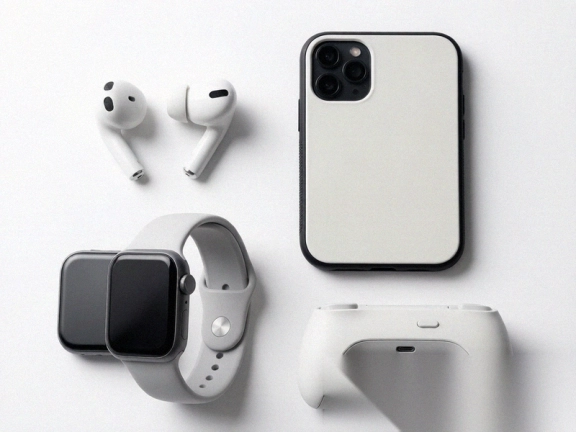
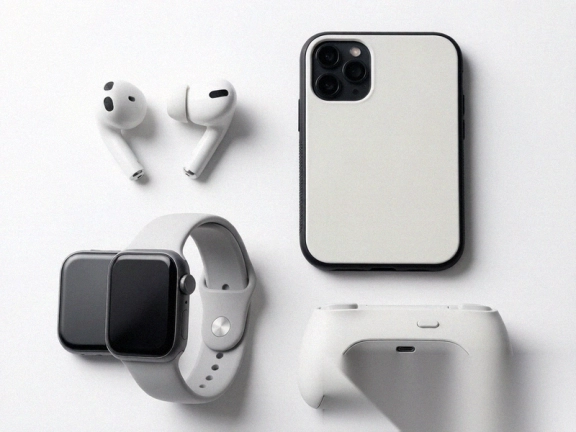
Figure 1: Overview of TPE applications in consumer electronics (wireless earbuds / phone cases / smart watch bands / game controllers)
2. Comprehensive Comparison of Four Common Soft-Touch Materials
Choosing a soft-touch material is essentially a balance among "feel, environmental friendliness, processing, and cost." The table below provides a horizontal comparison of TPE (SEBS-based), silicone, TPU, and PVC across the six dimensions most relevant to consumer electronics products—each row corresponds to a real pitfall point:
| Comparison Dimension |
TPE (SEBS-based) |
Silicone (LSR) |
TPU |
PVC (Flexible) |
Feel / Anti-slip
Shore A Range |
Soft and springy, good anti-slip
40–90 adjustable |
Softest but prone to oiliness and dust pickup
Becomes sticky with long-term use |
Harder, dry feel
Anti-slip only at higher hardness |
Harder, slippery
More brittle at low temperatures |
| Environmental / Certification |
Halogen-free, phthalate-free
RoHS / REACH compliant
Recyclable thermoplastic |
Inert and safe but hard to recycle
Thermoset, non-recyclable |
Some grades contain halogens
Specific formulation needs confirmation |
Contains halogens + phthalate plasticizers
High RoHS risk |
| Two-shot overmolding capability |
Strong adhesion with PC/ABS
No primer needed |
Requires primer treatment
Unstable adhesion |
Weak overmolding adhesion
Prone to delamination |
Basically cannot overmold
Only for outer jacket |
| Sweat resistance / Anti-yellowing / Odor |
Low odor, excellent anti-yellowing
Stable with prolonged skin contact |
Good, but noticeably attracts dust
High-temperature oil migration accelerates aging |
Good, transparent grades prone to yellowing
Hydrolysis in hot and humid environments |
Poor, plasticizer migration
Prone to yellowing, cracking, and oil bleeding |
| Injection molding cycle / Efficiency |
Short cycle, high efficiency
Suitable for mass production |
Long cycle (vulcanization)
Limited production capacity |
Medium cycle
Average efficiency |
Extremely fast but high compliance risk |
| Cost range (RMB/kg) |
13–30, high cost-performance |
30–80, expensive |
25–50, medium |
5–15, lowest but high hidden costs |
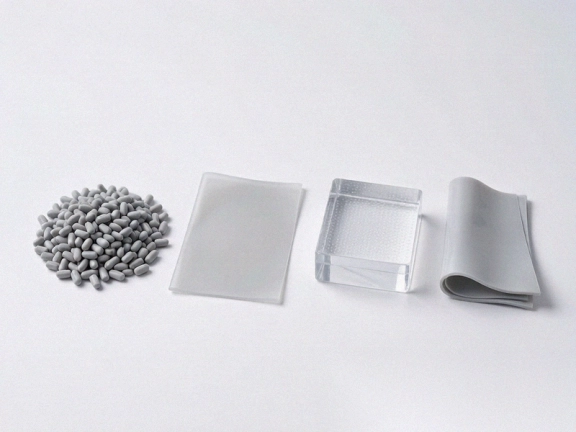
Figure 2: Physical comparison of four materials—TPE / Silicone / TPU / PVC (pellets, sheets, blocks)
III. Juye Recommended Grades and Key Parameters
For various consumer electronics scenarios, Juye offers a SEBS-based TPE modified series, covering the full hardness range from soft earplug segments to hard grip segments:
Hardness range: Shore A 35–90 freely adjustable. Ear tips use 40–60A (ultra-soft fit), phone case overmolding uses 70–85A (balancing feel and strength), handle grips use 80–90A (wear-resistant and anti-slip).
Full environmental certification coverage: RoHS and REACH compliant, halogen-free, phthalate-free, third-party test reports available, meeting欧美 brand factory audit requirements.
Strong bonding for two-color overmolding: Chemical bond-level adhesion with PC, ABS, PC/ABS, two-shot injection molding without delamination, eliminating primer and post-glue application costs.
Color and texture customization: Any color matching supported (Pantone color matching), matte skin-friendly / semi-transparent LED light-guiding / fully transparent grades available, matching different product design languages.
Sweat-resistant, anti-yellowing, low odor: Formula tested for skin contact stability, no yellowing, no oil bleeding, no unpleasant odor during long-term wear, reducing after-sales complaints.
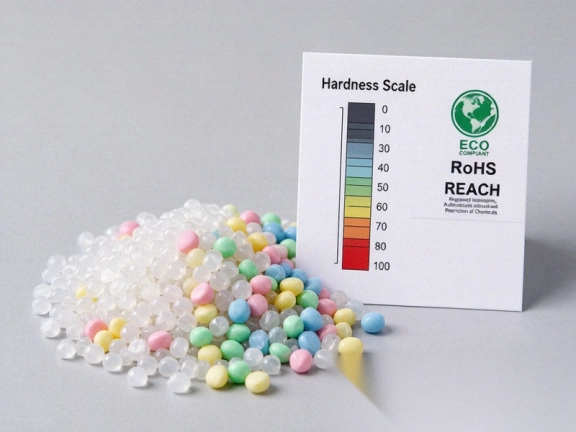
Figure 3: TPE modified pellets and physical property parameter card (hardness / environmental certification / color and texture)
4. Why are more and more consumer electronics brands switching to TPE? (Five advantages of the Juye solution)
Soft touch and anti-slip in one, saying goodbye to the "plastic feel":
SEBS-based TPE feels close to silicone but retains elasticity, no slipping or sticking when held, significantly improving the first impression of the product. This is the lowest-cost way for consumer electronics brands to enhance perceived premium value.
Eco-friendly, halogen-free, phthalate-free, directly addressing overseas market entry barriers:
Meets dual RoHS / REACH compliance, with halogen-free and phthalate-free declarations readily available, easily passing international buyer factory audits and Amazon platform environmental reviews.
Sweat-resistant, anti-yellowing, low odor, extending the aesthetic lifespan:
No yellowing, no oil bleeding, no odor after prolonged contact with human sebum and sweat; smart watch bands and earphone cases still look new after six months, significantly reducing after-sales return rates.
Strong bonding for two-color overmolding, one-shot molding eliminates the entire downstream line:
Overmolding with PC/ABS requires no primer or adhesive, bonding strength passes pull-off tests, eliminating manual assembly steps, boosting both yield and capacity—this means substantial cost savings for products with monthly production volumes in the hundreds of thousands.
Extremely high design freedom, even LED lighting effects can be achieved:
Color matching, matte / semi-transparent / transparent light-guiding grades available, making TPE not just a "texture layer" but also a visual selling point of the product.
5. Consumer electronics material selection pitfall checklist (6 high-frequency misconceptions)
Misconception 1: "The softer, the better"—ignoring hardness matching leads to poor feel
Many engineers only touch a sample and say it's "not soft enough," forgetting that materials as soft as 30A are difficult to demold during injection molding, have unstable dimensions, and overly soft feel actually makes users perceive the product as cheap. The correct approach is to set target hardness based on component function: ear tips 40–55A, overmolded frames 75–85A, grips 85–90A, and let Juye adjust the formulation as needed.
Myth 2: "Only looking at unit price, not total lifecycle cost" — choosing cheap PVC but losing brand reputation
PVC's unit price is indeed the lowest (5–15 yuan/kg), but once compliance risks from phthalate plasticizers emerge (e.g., new restricted substances added to the EU REACH expansion list), entire batches of inventory may be scrapped, products delisted from e-commerce platforms, and brand reputation damaged. Although TPE has a slightly higher unit price, it avoids hidden costs such as compliance fines, rework and mold redevelopment, and brand crisis PR.
Myth 3: "Ignoring two-shot injection molding adhesion" — samples look great, but mass production leads to delamination
Many brands use single-shot injection or hand-glued samples during the prototyping stage, and the feel is perfect. Only when moving to mass production with two-shot injection do they discover that TPU or ordinary TPE simply won't bond with PC/ABS, and after three months, delamination begins. Juye's overmolding modified grades are specially optimized for interfacial compatibility, providing process window parameters (melt temperature, injection speed, cooling time) to ensure strong, consistent bonding across mass production batches.
Myth 4: "Ordering without checking environmental certifications" — goods detained by customs upon arrival
For consumer electronics going overseas, RoHS (EU), REACH (EU SVHC list), and California Proposition 65 (US) are three unavoidable hurdles. Cases of PVC and certain TPU grades being rejected due to halogens or restricted substances are common. All Juye products come standard with RoHS/REACH reports, and halogen-free and phthalate-free declarations accompany shipments, ensuring hassle-free factory audits.
Myth 5: "Underestimating yellowing and oil bleeding issues" — great reviews at launch, but reputation reverses after a month
Silicone and low-quality TPE accelerate aging under UV exposure and skin oil contact: silicone absorbs dust and yellows, bleeds oil and becomes sticky; unmodified TPE formulations may leach low-molecular-weight substances causing surface tackiness. Juye TPE uses a hydrogenated SEBS base combined with anti-UV additives, and after 300 hours of xenon lamp aging testing, ΔE<3, ensuring color stability during shelf life and use.
Myth 6: "Using TPU for everything" — good abrasion resistance, but not suitable for all scenarios
TPU is known for excellent abrasion resistance and tear strength (tensile strength up to 25 MPa), but it has two critical drawbacks: first, transparent grades are prone to yellowing (especially in hot and humid environments), and second, its overmolding adhesion to hard plastics is far inferior to TPE. For consumer electronics housings, grips, and watch bands requiring "feel + appearance + overmolding," TPE is a more balanced choice; TPU is better suited for pure mechanical performance scenarios like cable sheaths, footwear materials, and industrial protective parts.
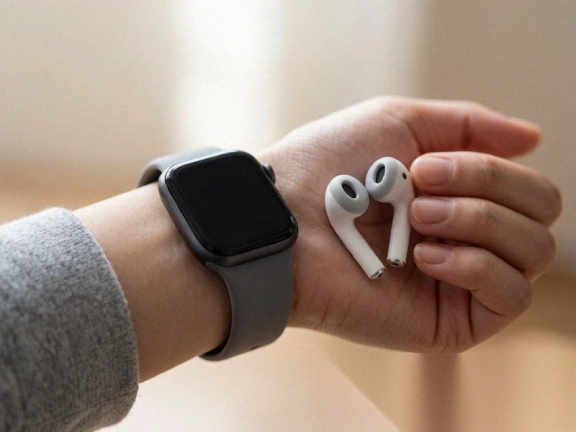
Figure 4: Real-life wearing of smartwatch strap and wireless earbuds (TPE skin-friendly and sweat-resistant · no yellowing with long-term wear)
VI. FAQ (Common Questions for Selection and Procurement)
How to choose between TPE and silicone? In what scenarios must silicone be used?
If your product requires extreme temperature resistance (>120°C or <-40°C), medical-grade biocompatibility (ISO 10993), or extremely low compression set seals, silicone is irreplaceable. For other consumer electronics housings, grips, straps, and overmolded parts, TPE is the more cost-effective first choice—similar feel, lower cost, supports two-shot injection molding, and is recyclable.
Will TPE overmolded on PC/ABS really not delaminate?
By using Juye's dedicated overmolding modified grades and strictly following our recommended process parameters (suggested melt temperature 190–220°C, mold temperature 40–60°C, medium injection speed), combined with good venting design, the bonding strength can pass the GB/T pull-off test. We provide free process debugging support until stable mass production.
How long does it take to issue environmental certification reports?
For regular orders, RoHS test reports and REACH compliance declarations can be issued before shipment; halogen-free and phthalate-free declarations are issued by Juye's laboratory. For special certification requirements (such as RoHS, SVHC, FDA food contact), please communicate in advance, and it usually takes 7–15 working days to complete.
Can free samples be sent?
Yes. Please contact Juye's business team to describe your application scenario and target hardness, and we will send matching TPE samples and physical property data sheets for your evaluation.
VII. CTA (Contact and Cooperation)
Dongguan Juye Plastic Technology Co., Ltd. specializes in the R&D and production of TPE/TPR/TPV/TPU/TPEE/TPV-SiR modified materials. With our own factory, controllable delivery times, and complete certifications (RoHS / REACH / halogen-free and phthalate-free), we have served earbud, mobile accessory, and wearable device projects for multiple consumer electronics brands.
Whether you are struggling with TPE consumer electronics material selection, need technical support for TPE two-shot overmolding, or want to verify the actual performance differences of TPE vs silicone vs TPU on your product—we welcome you to request samples and technical solutions.
👉 Contact Juye now: Get free samples and customized material solutions
Manager Zhang
Dongguan Juye Plastic Technology Co., Ltd.
Phone: +86 13827205072 (same as WhatsApp)
Email: juyetpe@juyetpe.com
Website: www.juyetpe.com
Address: No. 2, Fourth Street, Shu Jiu Second Industrial Zone, Changping Town, Dongguan City, Guangdong Province, China